1.3.4 Period 4 (1976-1981)
The maturing of the Awards structure. The transformation
of JACC into ACC.
Beyond the Organization and Management matters, Period 4
was dominated by two events: The aftermath of the very
successful and impressive IFAC Congress in Boston, and its
impact of the maturing of the AACC Awards structure, the
first one on US soil, and the sometimes agonizing push
towards revitalizing the JACC series.
The following set of subsections seems to cover the major concentration of interest in Period 4
A brief summary of these subsections follow.
1.3.4.1 Organization and Management of AACC in Period 4
The routine part of organization and management of well
established AACC had relatively few historic activities in
Period 4. Nevertheless some interesting occurrences are
reported in the following four digit subsections.
Most of these issues will be touched briefly here but more details are offered in Chapter 2.3.4.1.
1.3.4.1.1 AACC as the national member organization of IFAC
in Period 4
AACC continued this role with great efficiency
and a smooth structure of international cooperation.
1.3.4.1.2 Composition of AACC in Period 4
1.3.4.1.3 Constitution, Bylaws and ACC Operating Guide
Changes in these fundamentals in Period 4 were mostly
connected to the JACC-ACC transition discussed in
1.2.4.1.3.
1.3.4.1.4 IFAC 1975 Results
"IFAC'75 financial results were $263,000 income, total
expenses $249,000, balance $14,000 as of March 26, 1976.
The National Organizing Committee has acted to refund AACC
$2,500. AACC will establish disposition of the estimated
$6,500 final surplus at the direction of the National
Organizing Committee. Disposition to be within a five-year
period and to such a purpose as to be consistent with the
theme of IFAC'75."
More details of disposition in 2.2.4.1.4.
1.3.4.1.5 AACC-IFAC Committee Structure
The decision of IFAC to handle the IFAC Congress program
through its own technical committees by passing the NMO's
resulted in discussion of how the AACC technical committee
should be organized.
1.3.4.1.6 The Revival of ARC by Continued Funding in a
Reorganized form
As explained in 2.3.5 in 1975 ARC was without funding and
temporarily operating as an ordinary committee of AACC.
The effort to be funded, however, continued with heroic
vigor as was also explained in 2.2.3.5. These efforts led
to a renewal of interest and funding from NSF intended for
1976 after ARC was reorganized into two parts, one for
theoretical research and the other for practice. After
this revival however NSF funding was not continued and ARC
faded.
1.3.4.1.7 The AACC Newsletter
As a spirit of more direct cooperation within the AACC
developed in the process of giving more individual identity
to JACC in the form of ACC the feeling developed in the
Council for starting an AACC newsletter for better and more
direct cooperation with the people in the Systems and
Control (or Automatic control) field. Action in this
direction started with a statement by Hiro Mukai, the
prospective first editor to the #74 Council meeting on
March 3, 1981.
It was questioned whether funds required for the newsletter would be reflected in reduction of other accounts (e.g. advertising, publicity). The council's answer was that the newsletter funding will be additional to other expenses. Consensus was that two issues per year would be the proper frequency for distribution.
1.3.4.1.8 AACC Secretariat
An AACC Secretary was of course on the Council from its
beginning and he or his employer's staff handled the
relatively modest office work. As AACC and its operations
became established the office work grew and the need of a
regular staff operated office became apparent. So the
first step toward this was taken at the Board meeting #62
on July 27, 1976 to the effect that the establishment
toward a permanent secretariat of AACC operated under
contract by ISA will be pursued at a cost of $4,000-5,000.
This arrangement was actually worked out. Note that it
still left the Secretariate geographically separated from
the Secretary. Even so it was a large improvement at that
time.
1.3.4.1.9 American Automatic Control Council Treasurers
Duties
In conjunction to the JACC a ACC Transition the duties of
the Treasurer were reviewed and clarified as reported in
2.3.4.1.9.
1.3.4.1.10 Announcements in Period 4
"Jack Lozier: J. Lozier retired from Bell Laboratories
1/11/77. The Council adopted a resolution thanking Jack
for his years of service to the AACC and the Science of
Automatic Control and wished him health and happiness in
his retirement." (#63, 1977)
1.3.4.2 Development of the AACC Awards Structure in Period
4
AACC Awards started out in Period 2 with the Eckman and
Schuck Awards both aimed at the younger set of System and
Control researchers (who were the most active group at the
time), founded and operated in a regular but somewhat
casual spirit with no long range financial basis. They
were well designed and very fast because highly coveted and
prestigious awards and raise interest in an expanded and
well organized Award structure with a firm financial
foundation. The latter need created a problem as it did in
the multidimensional society structure of AACC.
A breakthrough came in the form of the surplus funds left from the 1975 JACC congress in Boston. These funds were very carefully handled by the Council and very careful analysis and planning of their use was interested in developing the most effective use for them. This is discussed in the section of the 1975 IFAC in this Period 4. The optimization of using these funds stimulated a most thorough and detailed analysis and to a large extent the certification of the entire AACC Award Structure through a Special Committee under the leadership of Bill Perkins. An excerpt of which (from 2.3.4.2) follows.
Revised June 23, 1977
This program has three major segments: Annual individual Honors Awards which incorporate the two existing individual awards, an Application Workshop program to be held one day ahead of the annual JACC meeting, and the establishment of a Control Heritage "Hall of Fame" to memorialize decreased past contributors to the control field.
Four Honors Awards would be given:
" INDIVIDUAL HONORS AWARD
Candidates for these awards would be solicited and selected annually by an expanded AACC Awards Committee based on the following criteria:
3.2 Eckman Award
3.3 Hugo Schuck Award
3.4 Education Award
The Education Committee will be responsible for the preparation and duplication of the video tapes and their publicity. Distribution will be handled by the AACC Secretariat."
"CONTROL HERITAGE HALL OF FAME
The purpose of the Control Heritage Hall of Fame is to memorialize decreased individuals who have made major career contributions to the control field, and who have done their work primarily in the U.S.A. Selections will be made by the Awards Committee." "ANNUAL AWARDS LUNCHEON
The Honors Program Awards and the Application Workshop Certificates are to be presented at the Annual JACC Awards Luncheon.
A suitable awards brochure will be prepared by the Awards Committee (see Section 7) for distribution at the luncheon. This brochure will list the awardees, case study selections and a brief description of the reason for their selection."
For more details on the Awards structure see Chapter 2.3.4.2.
1.3.4.3 The Transition of JACC into ACC in Period 4
(1976-1981)
The dominant activity of AACC Council during Period 4 was
concern of the future of JACC. Clearly drastic change was
indicated and the difficulties and possible solutions were
thoroughly analyzed in the preceding period 3 under the
leadership of Herman Weed but no actual plan was proposed.
What then happened was that in the first part of the period
JACC was sort of left to drift and experiment (Section
2.2.4.3.1) with various changes such as moving to hotels.
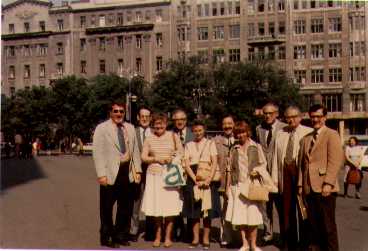
Then in 1976 a serendipitous chance created a near ideal
informal working group on a bus ride in Russia where a plan
developed and was implemented in a new series of meetings
later named ACC (2.2.4.3.2).
1.3.4.3.1 The Fading Away of JACC Arranging the Final
1976-1981 JACC Sequence
This history is described in Section 2.2.4.3.1. It shows
some interesting experimentation e.g. in hotels and/or
jointly sponsored by two sponsoring Societies. The final
1981 JACC (W. Virginia, ASME) was a fully conservative
demonstration of the original JACC with its strengths and
weaknesses. Details are discussed in 2.3.4.3.1.
1.3.4.3.2 The Birth of the American Control Conference
ACC
In the years 1976 to 1978, as is described in 2.2.3.3 the
problems of JACC were universally acknowledged. The report
of the Steering Committee led by Herman Weed
and quoted in 1.2.3.3 and 2.2.3.3 was a very complete analysis of these problems and possible
individual remedies, but most people felt more or less explicitly that more was needed than
patchwork type approach to individual problems. Yet the political difficulties in this still very
loose alliance were such that, for instance, eliminating the yearly rotation in JACC was only
softly mentioned occasionally. Patchwork was tried to some extent in Period 3 with some
success but clearly more was needed. So in 1976-79 the year by year JACC's experimentally
tried things like moving the meetings from campuses to hotels or convention centers-successfully
but no permanent change was made as described in Section 1.3.4.3.1. Interestingly the
emergence of a detailed specific plan for a meeting series run by AACC led through a few events
emerging from outside the regular AACC organization. Specifically there were four such events.
This process is summarized here. More details in 2.2.4.3.
The major impact of this is as a message directly from the IEEE President is to the effect
b.) A strong demand for reform of JACC. Some possible reforms are mentioned in this report but relatively casually and basically unconnected. No specific solution is advocated in this report."
The important aspect of this fact of unrest about JACC in IEEE and the presidential level support of a cooperative national meeting subject to drastic reforms coming from the most powerful and active society in AACC gave strong impetus to a well designed overall and detailed plan for reform of JACC."
Original Group Photograph AACC visitors in Russia:
From
left: Mike Rabins, Harold and Mrs. Chestnut, Nat and Mrs.
Cohn, Mike and Mrs. Athans, Charles Doolittle, John
Zaborszky, Jim Medich
Of course, most of the time on the bus was filled with talk about JACC and as a matter of fact the trip became a planning workshop for the future of JACC. Looking at the list of participants it will be clear that those present would represent the best selection for a planning workshop for this task. Hal Chestnut was the principal founder of IFAC-AACC and past IEEE President. Nate Cohn was the moving spirit of the 1975 IFAC Congress. John Zaborszky was then Vice President (unusually active in this post because of external circumstances) and President elect for AACC. He had experience in professional society organizational maneuvering. As chairman of the IEEE group on Automatic Control in 1970 when IEEE decided to create a new IEEE Society status originally meant to apply only to the Computers and the Electric Power groups, Zaborszky with the help of Hal Chestnut, then IEEE President, pushed through the creation of the Control System Society as the third Society created on the first round. Of course all groups then eventually became Societies after this, changing the IEEE structure into its present conglomeration of cooperative autonomous societies (around 35 many not actually electrical or electronic). Zaborszky also was instrumental in starting the Decision and Control Conference meeting series and allaying misgivings in AACC. Mike Rabins (ASME) and Jim Medich (IEEE) were directors respectively for the two societies dominating AACC in activity and productivity. They had experiences and talents like Zaborszky's, familiarity and influence both in their Societies and AACC and diplomatic skill to deal with the sensitivities of their societies. Mike Athans was current or recent president of Control System Society and IEEE director of AACC, general chairman of the first Decision and Control Conference.
Doolittle had an active and effective career in AACC of which he was past President.
Clearly it would be difficult to select a more competent and promising small set of participants for a planning workshop on the future of JACC. This chance and informal workshop inevitably started as soon as they got on the bus. There was plenty of time for discussion. There was no chair, no notes taken and no vote but a clear picture of efficient solutions emerged.
Since the scope has developed quite clearly on the bus the work proceeded fast and a well thought out and carefully written first draft was ready for presentation at the #69 Board meeting on June 20, 1979 in Denver.
Because of its historical significance as the beginning in specific terms of what has become the ACC age of the joint national control conference under the authority of AACC this document will be included in this Preface as follows.
JACC Operated by AACC
JACC is the annual national meeting in the control and systems field operated by the AACC representing its member societies jointly with the participation of the member societies and under their joint financial responsibility.
The Steering Committee sets policy for the operation of the JACC including the overall composition of the program, the sites and times of the meetings, the fee to be charged, the financial goals to be attained, and the promotional practices.
The Steering Committee also proposes persons to serve as General Chairmen and program Chairmen for each year's JACC. These are appointed by the AACC at least two years prior to the meeting (and certainly early enough for making arrangements on hotels, etc.). There should be a proper spread in the society identification of these individuals over the years (e.g. not to be strongly identified with the same society in consecutive years), but they do not represent individual Societies, they represent AACC. Actions of the Steering Committee are subject to approval by the AACC.
2.2) The Local Arrangements Committee.
2.3) The AACC Headquarters Staff. The staff will operate under instructions from the General Chairman and the Operating Committee and provide staff support to them in selecting a printer, publishing and distributing the preprint volume and in making arrangements with hotels and/or universities.
The program committee operates as an AACC committee and not as a body of society representatives. They have exclusive, ultimate authority for specifying the conference program.
The composition and flavor of the program should maintain a year by year consistency but not internal uniformity. It should serve varied interests of the attendees and serve as a kind of "bazaar" where each society can show their wares, the results of their technical activities representing their own interests and their own standards. As a general standard Societies should determine if a contributed paper is of sufficient quality to be published in a refereed paper of the Society.
It is not the aim of JACC budgeting to build up substantial reserves for AACC. JACC should, however, provide for some of the basic costs of AACC such as headquarters expenses and IFAC dues.
The following basic structure is proposed for the disbursement of the JACC receipts.
7.2) The remaining surplus (or deficit) is shared among the Societies according to their weighted participation so that the society receives the following fraction of the funds to be distributed.
7.3) Since a major part of the JACC income is deferred in the form of post conference sales of the volume it is expected that after each JACC a yearly incremental distribution is made for up to 5 years. The copyrights for the JACC volume would be held by AACC and a share of the sales receipts would be assigned to AACC mainly to cover handling and warehousing expenses.
Note 1. Such a plan would provide a fixed share for each society to cover at least part of the basic load of AACC headquarters expense and IFAC dues. There will be a yearly AACC dues to cover the rest.
Note 2. Societies would be rewarded for effort in contributing papers and generating attendance. One objection may be that the Societies no longer have control on how many of their contributions are actually included in the program, however, the Program Committee would be unlikely to disproportionately exclude one society's contributions.
This proposed plan was discussed at the Board Meeting #69 in June 20, 1979. J. Zaborszky led discussion on the May 15, 1979 draft proposal which is attached.
M. Rabins reported that ASME supported the proposal in principle but there were some concerns over details, e.g., the formula for sharing profits is not satisfactory for sharing risks, and the determination of the AACC Headquarters staff overhead should be spelled out in detail.
The intention is for the individual societies to retain the copyright of the papers they contributed.
J. Meditch reported that the proposal had been distributed to IEEE CSS Adcom in January with no adverse comments. It will be discussed further at their Thursday meeting.
It was moved and unanimously passed to accept the proposal as a basis for a constitution and bylaws amendment to be presented at the next Council Meeting #70 in December 1979.
Of course there is a long way beyond a new Constitution and Bylaws for developing a working plan for a meeting type so different from the original. Many small and large steps need to be taken to provide such a detailed plan as a basis of implementing the new meeting sequence into a successful start. With the positive spirit all around the planning phase was successfully completed by the #76 December 1981 Board meeting, the last presided over by President Zaborszky. Because of the complex multiple developments under his period which produced the plans for the new ACC series, Zaborszky prepared a Presidents Report on the subject which contained a collection of all documents constituting the plan for the new ACC meeting series.
This report is included as Appendix 2.3.2.4.3.
This collection is enclosed as Appendix 2.3.2.4.3.2B which covers the subjects
Of course beyond ACC itself this plan for change raises the issue of a sufficiently efficient Headquarters office for AACC itself to replace its previous shaky arrangements while JACC was operated by the individual societies themselves. Arrangements made in 1980 we reported in Section 2.3.2.4.1.8. This turned out to be a rather difficult issue not fully resolved at the time of this presidential report. Eventually an attachment of the secretariat to the secretary at his location was the logical solution adopted.
Another additional planning area involved the duties of the Treasurer when AAC is included in Section 2.3.2.4.1.9.
These latter two items go beyond ACC and affect the whole AACC. Consequently they are discussed in Section 2.3.2.4.1 on Organization and Operation and are enclosed in Sections 2.3.2.4.1.8 and 2.3.2.4.1.9. A detailed summary on AACC Honors and Application programs documented in Section 2.4.2.
A major step during this Period 4 was the start of an AACC Newsletter also discussed in Section 2.4.1.7.
Of course the organization of a new major meeting series like ACC on the structural and political level needs to be accompanied by a proper planning of the Operations Manual level for organizing the individual meetings. This was accomplished by making plans by the new ACC Operations Committee under the guidance of Mike Rabins the Chairman of the first ACC in 1982 and Yakov Bar Shalom on the program chairman of 1982 and J. Zaborszky the AACC President.
A good summary of the progress of this meeting plan and operating manual was emerging in a rich flow during 1981 which is presented in Appendix 2.3.2.4.3.2.B roughly organized by topic through presenting the individual pieces of reports offered at the #76 Board meetings of 1981. A list of headings follows:
The partial assortment of these steps that needed to be established is given in Appendix 2.3.2.4.3.2.B emanates the enthusiasm and thoroughness of the group spearheading the ACC series through ACC 1982. An organizations Operating Manual which emerged will be presented in the Period 5 history.
Thus Period 4 ended successfully for the reorganization of JACC name. Agreement has been achieved on AACC operation of JACC - now ACC (the name proposed by Mike Rabins) with a happy consensus of all Societies so that it actually solidified the cooperative spirit of the Societies rather than strain it. A detailed and comprehensive plan has been worked out in a harmonious spirit for the operation in all its aspects including wider matters involving the AACC itself, the beginnings of an Operating Manual, including its Constitution and Bylaws, etc. financial operation and its Secretariat and a contract with IEEE for selling the AAC Proceedings outside the meeting itself. An AACC Newsletter has been started to communicate with the meeting audience.
This is however not the end of the creative effort to implement the plan for ACC 1982 in Washington DC. The success of implementation will ultimately determine the future life of ACC and AACC itself.
Fortunately, the future was left in excellent hands both veterans deeply involved in the planning phase.
Tom Stout as President of AACC and Mike Rabins as the general Chairman of the first ACC and Vice President to be President in 1984-86, ideal choice for his prominent role during the planning steps.
Y. Bar Shalomas Program Chairman for 1982 is just as ideally promising. So "On to Period 5", the age of ACC.